
Gods Walking with Men
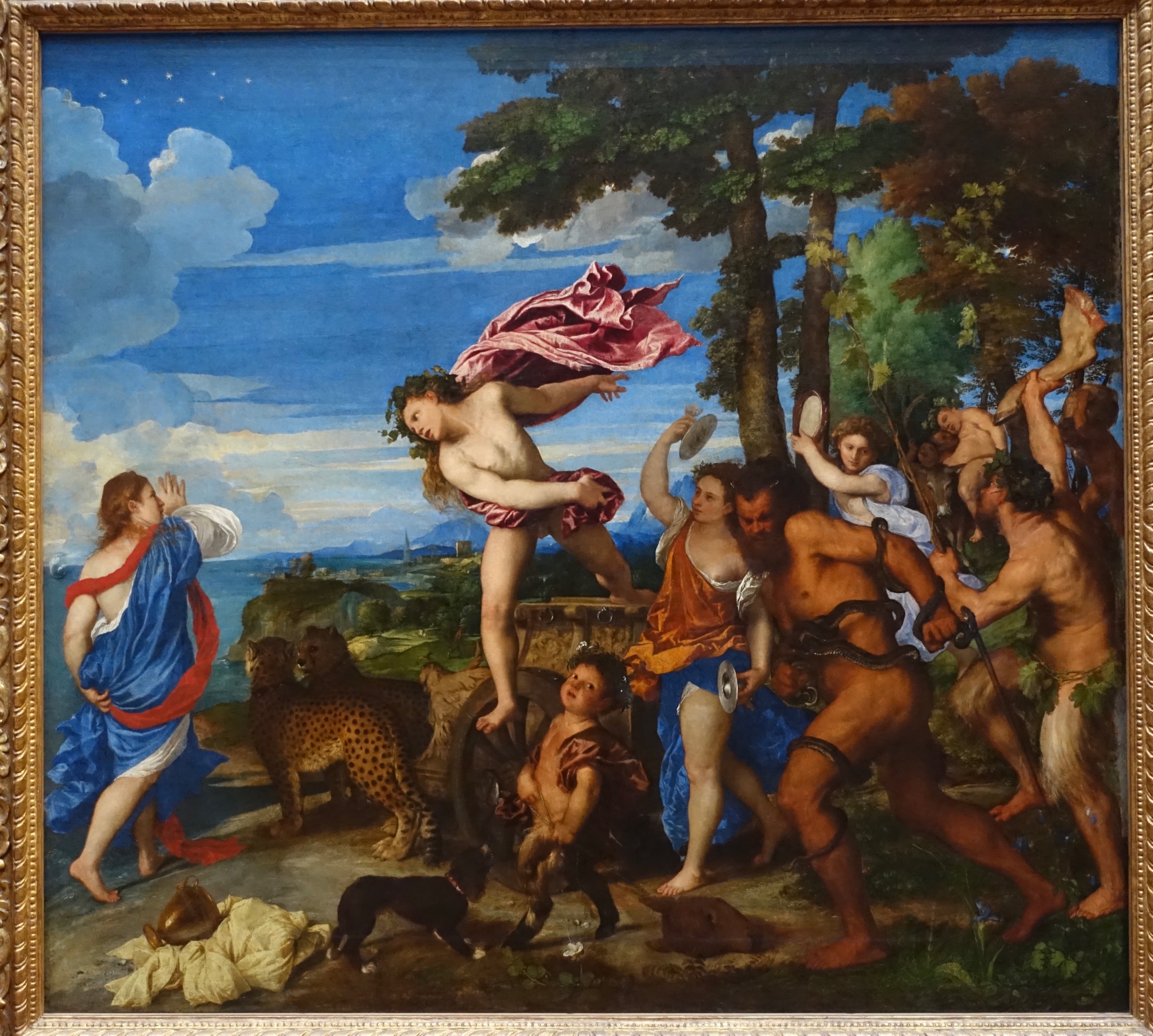
Titian - Bacchus and Ariadne
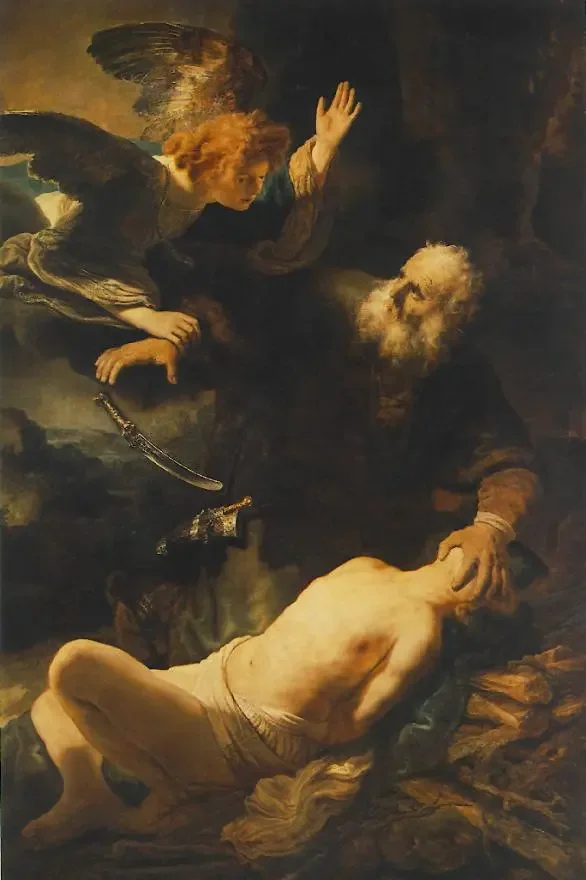
Rembrandt
Abraham is considered to be the original founder of Judaism, Christianity and Islam. One day his god told him to kill his son. Abraham meekly went about doing what he was told (note that in another story Abraham argued with his god to spare the few good people of Sodom and Gomorrah). When Abraham was ready to kill Isaac an angel (what is an angel?) held back Abraham’s hand, and a ram that was conveniently caught in a nearby bush was sacrificed instead. Some anthropologists say that this story is merely a parable about when people stopped making human sacrifices.
Elements of this story have a Greek equivalent. Agamemnon was advised that he would have to sacrifice his daughter, Iphiginia, before the proper winds would blow to allow the Greeks to sail to Troy (to rescue Helen from Paris and the Trojans). After much deliberation Agamemnon agreed to sacrifice his daughter, but at the last minute a goddess appeared and replaced the daughter with a ram.
As wrestlers you must make sacrifices, but you must not sacrifice either school work, wrestling practices, or chores at home.
Greek Vases from 500 BC
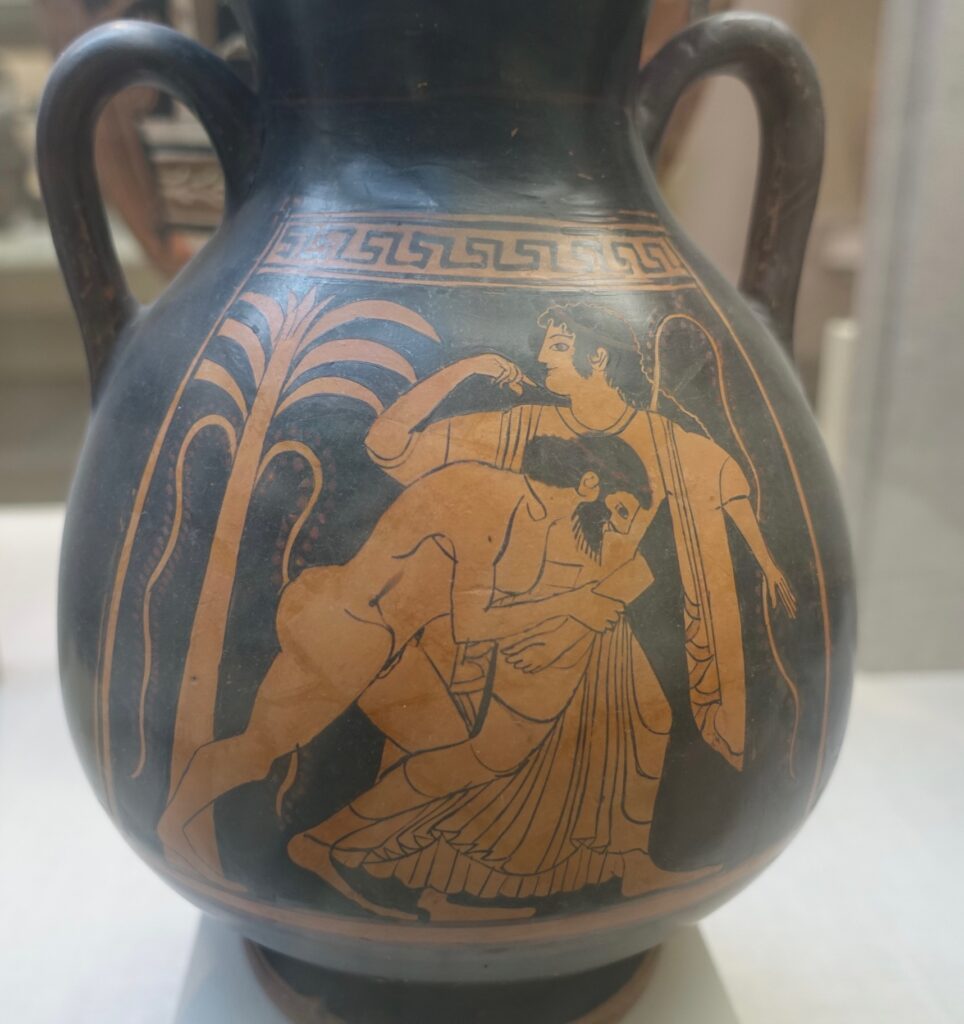
The painting on the above Greek vase shows the mortal Peleus wooing the Greek Nereid (a form of minor goddess) Thetis. Peleus was one of the Argonauts that accompanied Jason when he went for the golden fleece. Zeus and Poseidon had previously had eyes on the beautiful Thetis, but a prophesy said her son would be stronger than his father. They kept away. The Greeks did not have dating apps, but Zeus himself introduced Peleus to Thetis. She played hard to get and ran away. Peleus had to catch Thetis and wrestle her to the ground to win her hand in marriage. Looking at the image you might think she should have sprawled and stuffed his head, but his set up was good and he penetrated deeply and completed the takedown. They had a magnificent wedding and all the gods and goddesses were invited. Achilles was the fruit of their union. He was a “hero.”
the next thing Our favourite sport was part of the original Olympic Games in 776 B.C. There were no weight classes then, so the big guys had the advantage. In Homer’s Illiad (the story about the Trojan war) there were wrestling matches at the funeral games for both Patroclus and Achilles. The Trojan War was a real event that took place some time around 1250 B.C.
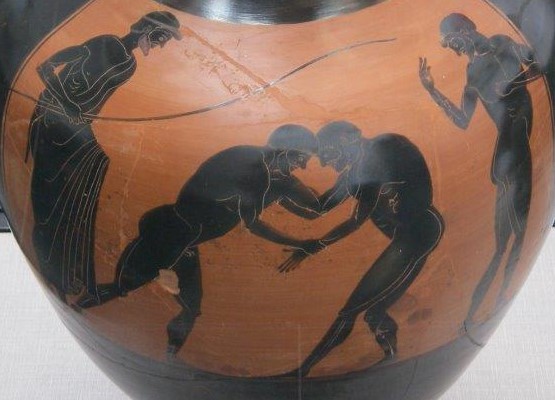
See the image on the vase. It appears that the wrestler on the right does not have a proper stance. His left leg is very exposed. To see comments and a video on stance [click here].
Patroclus, who was the best friend of Achilles (the Greek hero), borrowed the armour of Achilles and slaughtered many Trojans. Achilles himself refused to fight due to a huff over a woman. Hector, the son of the Trojan king Priam, killed Patroclus after Apollo blurred the vision of Patroclus and knocked his helmet off.
In a fit of anger and revenge Achilles re-joined the war. He killed Hector and dragged Hector’s body behind his chariot around Troy and then back to the Greek ships. Apollo eventually killed Achilles with a poisoned arrow to the heel. Some versions of the myth have Paris shooting the arrow. Paris was the lover of Helen of Troy (the most beautiful woman in the world), and he started the war by stealing Helen from the Greek king Menaleus. We all know who eventually won the Trojan war.
But back to Patroclus. After killing Hector, Achilles insisted on stopping the war to hold a proper funeral for Patroclus. It was customary to have games at such a funerals. Wrestling was naturally included. The final match was between Odysseus and Ajax, and they battled to a tie. Nowadays we have ties when we go to formal functions, and the educated wrestler may forge ties of friendship that last a lifetime, we but we don’t have ties in our wrestling matches. In many cases the person who scores the technical move with the highest point value (like a five point throw). All other things being equal the wrestler with the last point scored will win, so you should always be prepared to go as hard as you can near the end of a bout, even to the last few seconds.